
Review · BERLIN
Daily First Rickshaw promotion in Combi Vehicle public Group 90€
Berlin is a large city with major sights spread across wide boulevards and former East and West sectors. This four-hour private rickshaw tour gives you a seated ride between them, beginning near Alexanderplatz and reaching the Holocaust Memorial, Potsdamer Platz, Checkpoint Charlie, and Brandenburg Gate without making you walk the full distance.
I like the easy pace and the close-up views. I also like the flexibility: the driver can stop for photos, adjust the commentary to your interests, and keep you covered with a roof and blanket if Berlin weather turns wet. The main drawback is the price for only two people, and admission to museums or the TV Tower is not included.
One guide named Levi receives especially warm praise for his humor, local knowledge, photography, and ability to adapt the route to personal interests. The experience is best for a couple, two friends, or anyone who wants a broad first look at Berlin with very little walking.
Key points to know before booking
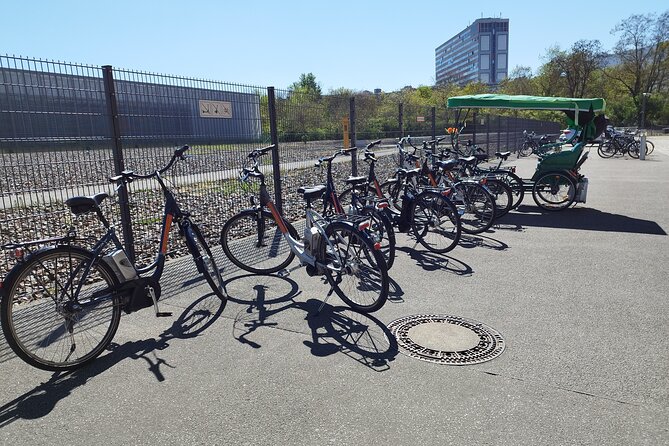
- Private ride for up to two people: You get the rickshaw to yourself rather than joining a large sightseeing vehicle.
- Four hours across central Berlin: The route links Alexanderplatz, Museum Island, Bebelplatz, Checkpoint Charlie, Potsdamer Platz, and Brandenburg Gate.
- Comfortable for limited mobility: You enter the rickshaw in a few steps, and the driver can bring you close to many monuments.
- Strong guide element: Levi is named in the feedback, with praise for clear explanations, humor, photography, and safe driving.
- Outdoor sightseeing rather than museum touring: The stops are mainly viewing points, so museum admission and the TV Tower visit cost extra.
- Early starts may feel calmer: A 9:00 a.m. departure was specifically recommended for quieter conditions around the sights.
Why a rickshaw works well in Berlin
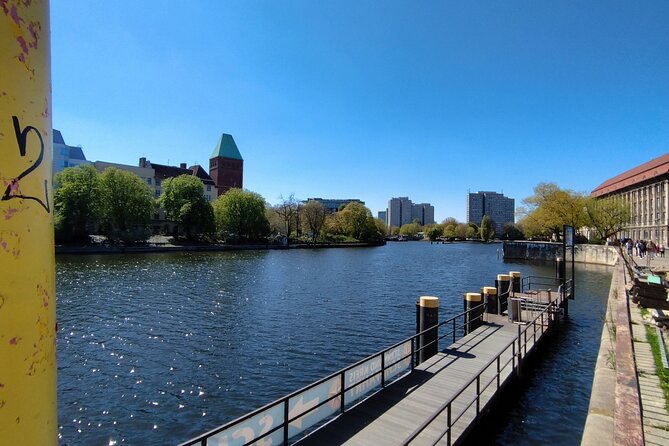
Berlin rewards anyone who understands its geography. The city center is not one compact old town. Instead, important places are scattered between former East Berlin, former West Berlin, government buildings, memorials, broad public squares, and modern developments.
A rickshaw solves part of that problem. You sit close to street level, see the city without a window between you and the buildings, and move from one district to the next without spending your energy on long walks. The driver also handles the route, which lets you focus on the explanation and the view.
This is not a private car tour. The ride is more open, slower, and more exposed to the weather. That is a fair trade for being able to pull over easily and get near many sights. The supplied blanket and roof matter, particularly in Berlin’s changeable weather. One especially positive account describes a guide continuing to explain the city during a rainstorm, then using the rickshaw’s cover and blanket to keep the passenger comfortable.
The vehicle holds a maximum of two people. That makes the tour personal, but it also limits the value for a larger party. Extra rickshaws can be added for bigger groups, although each vehicle should be considered a separate ride.
More Rickshaw Tours in Berlin:
- Berlin: Private Guided E-Rickshaw Tour
★ 4.9 · 157 reviews - Individual City Tour – Rickshaw Sightseeing in Berlin
★ 5.0 · 120 reviews - Berlin Express: Private 1-Hour E-Rickshaw Ride
★ 5.0 · 116 reviews
Alexanderplatz and the route toward Museum Island
The meeting point is Weinbergsweg 6 in Berlin’s 10119 postal district. The sightseeing begins at or near the Berliner Fernsehturm, the 365-meter TV Tower on Alexanderplatz, one of the clearest orientation points in the city.
You first pass several central landmarks, including the Red Town Hall, Marien Church, and Neptune Fountain. These early sights give you a quick introduction to Berlin’s changing center. Alexanderplatz itself has a modern city feel, while the nearby historic buildings hint at how much of the area has been rebuilt and reshaped.
The TV Tower is a viewing attraction in its own right, but its admission is not included. The tour treats it as an exterior starting point, so you should not expect a tower visit unless you arrange and pay for that separately.
From here, the ride continues toward Museum Island. The benefit is scale: you begin to see how close some of Berlin’s most important buildings are to one another without walking from square to square.
Museum Island: Berlin’s greatest concentration of culture
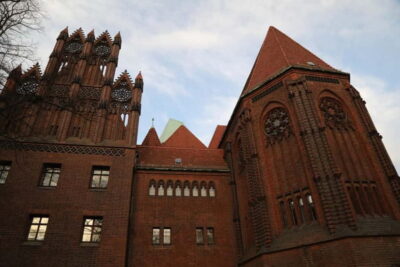
Museum Island is a UNESCO World Heritage site and one of the tour’s most rewarding outdoor stops. The complex includes the Berlin Cathedral, the Altes Museum, the Neues Museum, the Bode Museum, and the Berlin City Palace area.
You receive about 15 minutes here. That is enough for photographs and an explanation of the buildings, but not enough to visit the museums. Admission to the outdoor stop is free, while museum entry is not part of this experience.
I would treat this as an orientation visit. If you plan to see the Egyptian collection at the Neues Museum, the ancient art at the Altes Museum, or other collections, set aside another part of your trip. The rickshaw tour helps you decide what deserves more time later.
The close street-level position is useful here. You can take in the domes, facades, river setting, and surrounding public spaces without rushing through a long pedestrian route.
Bebelplatz and the memory of the 1933 book burning
Bebelplatz is a compact square with a heavy story. It forms part of the Forum Fridericianum, a group of major buildings that includes the State Opera, Humboldt University, the State Library, and St. Hedwig’s Cathedral.
The square is best known for the Nazi book burning held there on May 10, 1933. The regime burned books it considered un-German, using the event to display its control and silence opposing ideas.
You stop for about 10 minutes, with no admission fee. This is a place where the guide’s explanation matters more than the amount of time spent standing there. Look for the underground memorial, which recalls the empty shelves left behind by the destruction. The stop is brief, but it gives the rest of the tour a serious historical frame.
If you prefer sightseeing that stays light and purely scenic, this part may feel sobering. That is also its value. Berlin does not hide the difficult chapters of its past, and a good guide should explain them plainly.
More tuk tuk tours around Berlin:
- Rickshaw Tours Berlin – Groups of up to 16 people with several rickshaws
★ 4.0 · 97 reviews - Rickshaw Sightseeing City Tours Berlin – Rikscha Tours
★ 4.0 · 55 reviews - Berlin: Private Sightseeing Tour in an E-Rickshaw
★ 4.9 · 44 reviews - One Up to 3 Rickshaws(6 GUESTS)-Taylor Made Rickshaw Berlin Tour
★ 5.0 · 20 reviews
Gendarmenmarkt and the elegance of central Berlin
Gendarmenmarkt provides one of the tour’s most polished city views. The square is framed by the German Cathedral and French Cathedral, with the former Royal Concert Hall at the center.
You have roughly 10 minutes here for photographs and commentary. The square’s symmetry makes it easy to appreciate from a seated position, and the surrounding buildings show a different side of Berlin from the broad modern spaces around Alexanderplatz.
The square has also seen restoration and change over time, so you may find some areas less picture-perfect than expected depending on current work. Still, the basic composition is impressive, and this is one of the best stops for a quick architectural photograph.
Checkpoint Charlie and the former Berlin Wall line
Checkpoint Charlie is one of Berlin’s most familiar Cold War locations. It marked a crossing point between the American and Soviet sectors during the years when the Berlin Wall divided the city.
The stop lasts about five minutes. That may sound short, but the rickshaw can bring you close, and the guide can explain the meaning of the former border strip without requiring a long walk. You will see the area as a reminder of the 28 years when families, friends, and neighborhoods were separated.
The present-day checkpoint is not an untouched Cold War scene. Some displays and nearby attractions are modern recreations, and the area can feel commercial. That is worth knowing before you arrive. Its importance comes from the events connected to the place, not from expecting a perfectly preserved border crossing.
The rickshaw format is helpful here because you can take in Checkpoint Charlie, hear the context, and continue toward the remaining sections of the former Wall without losing time to a long pedestrian detour.
Topography of Terror and the Nazi-era government district
The Topography of Terror documentation center occupies the site of former Nazi security offices. It presents the history of the institutions and people responsible for persecution and mass violence during the Nazi period.
The tour allows about 10 minutes at this area, with free admission for the outdoor visit. That is not enough time to explore the documentation center properly, so think of this as a first introduction. If modern German history is a main interest, you should return for a longer visit.
Nearby is Martin-Gropius-Bau, an exhibition building that has hosted major shows by figures such as Ai Weiwei and David Bowie. The former Prussian Landtag is also in this part of Berlin, adding another layer of political history.
This section works particularly well with a guide who can connect the buildings to the events that took place around them. You are not just looking at attractive facades. You are moving through locations linked to dictatorship, political power, war, and the rebuilding of public life.
Potsdamer Platz and Berlin’s modern comeback
Potsdamer Platz shows Berlin’s post-reunification ambition. After World War II and the years of division, the area was largely damaged and neglected. Following German reunification in 1990, it became one of Europe’s largest construction sites.
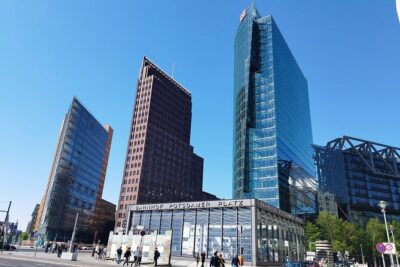
Today, the Sony Center and neighboring towers create a sharp contrast with the historic squares earlier in the tour. The architecture is modern, large-scale, and designed to signal a new Berlin. You receive about 10 minutes here, enough to see the main complex and take photographs.
I find this stop useful because it prevents the tour from becoming a parade of older monuments. Berlin is not only a city of imperial buildings and memorials. It is also a city that rebuilt itself in full view, sometimes with bold results and sometimes with architecture that divides opinion.
The Holocaust Memorial and a quiet pause
The Memorial to the Murdered Jews of Europe is made up of 2,711 concrete blocks arranged across a large open site. It commemorates the six million Jews murdered under National Socialism.
The tour gives you about 10 minutes here. The memorial is free to view, while the underground information center is separate and is not included in the tour. You can walk among the blocks if you choose, though the rickshaw format means you can also remain close to the vehicle and still take in the site.
This is not a place for hurried jokes or a quick checklist photograph. The memorial’s changing height and uneven ground create a physical sense of unease, though the meaning is open to personal reflection. The guide’s role should be to provide clear context and allow you space to think.
If you want to visit the underground exhibition, plan another time. Ten minutes is useful for orientation, but it cannot replace a full visit.
Brandenburg Gate and the government district
Brandenburg Gate is the final major landmark listed on the route. Once associated with the division of Berlin, it later became a powerful symbol of reunification and remains one of the city’s best-known monuments.
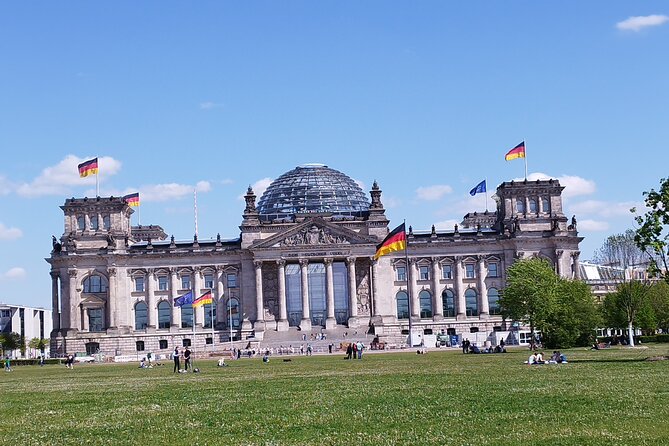
The tour then moves toward the Memorial to the Murdered Sinti and Roma and the government district, including the Reichstag, Bundestag, and Federal Chancellery. You can see how the ceremonial center of Berlin connects with present-day political institutions.
The listed stop time is about 10 minutes. The route returns to the starting point at Weinbergsweg 6, so this is a broad circuit rather than a one-way transfer.
Because Brandenburg Gate is often crowded, the timing matters. A 9:00 a.m. start was specifically recommended for quieter conditions. An early departure can also make photography easier and reduce the feeling that you are trying to see the monument through a wall of people.
What the four hours really give you
The named stops add up to roughly 85 minutes of scheduled stopping time. The rest is riding, explanation, short pauses, and movement between districts. That is a good structure for a first day in Berlin because you receive both an overview and enough context to decide where to return.
The tour is not designed for long museum visits. It is also not a deep historical seminar at every location. Instead, it connects many key sites in one sitting and lets you see how Berlin’s imperial, Nazi, Cold War, reunification, and modern eras sit beside one another.
The private format makes a real difference. You can ask questions, request more photo stops, and tell the guide what interests you. One account specifically praised the driver for adapting the tour to personal interests and finding places that standard sightseeing routes might skip.
Guide style, comfort, and what is included
Guide quality is central here. Levi is the guide named in the available feedback, and he is described as friendly, humorous, informative, and skilled at maneuvering the rickshaw. He is also praised for taking photographs, which is useful if you want pictures of both people in your group rather than another set of monuments.
The tour includes the rickshaw, an experienced guide, WiFi on board, bottled water, and alcoholic beverages. Tips are not included. Since guides can vary by date, you may want to ask at booking if Levi is leading your departure.
The rickshaw has a roof, and blankets are available. That makes the tour more practical in cool or rainy weather, but you should still dress for outdoor conditions. You remain outside for much of the four hours.
The experience is also suited to people who do not want a demanding walking day. You enter the rickshaw in a few steps, and the vehicle can stop close to many monuments. It is not described as fully wheelchair accessible, so anyone needing a specific transfer arrangement should confirm before booking.
Price, group size, and value
The stated price is $216.74 per group of up to two people. Another promotion title references a 90 euro daily first-rickshaw offer, so check the exact price and currency before you pay. Prices and promotions can change, and the difference is large enough to matter.
At the standard listed price, this is not the cheapest way to see Berlin. You are paying for a private vehicle, a four-hour guide, flexible photo stops, and the convenience of covering a wide area without walking between every sight. For two people, the cost is easier to justify than for one person.
The value is strongest when you are short on time, have limited mobility, or want a personal introduction before exploring independently. It is weaker if you prefer to spend hours inside museums, use public transportation confidently, or see Berlin at the lowest possible cost.
Who should book this Berlin rickshaw tour?
I would choose this tour for:
- Couples who want a private sightseeing ride
- Two friends sharing the cost
- First-time visitors who need a city overview
- People who prefer limited walking
- Photographers who value frequent stops
- Anyone who wants a guide who can adjust the pace and subject matter
I would look elsewhere if you want a large group atmosphere, a full museum program, or a strictly budget-priced tour. The four-hour duration is long enough for a serious overview, but it is still an introduction rather than a complete study of Berlin.
Should you book it?
Book this rickshaw tour if you want to see many central Berlin landmarks comfortably and understand how the city’s major eras connect. The private format, small capacity, photo stops, roof, blanket, and guide-led explanations give it more personality than a standard drive-by sightseeing loop.
Before booking, confirm the current price, ask which guide is scheduled, and choose an early start if possible. Remember that the TV Tower and museum interiors require separate admission and time.
If you want a gentle, personal first look at Berlin, this is a sensible choice. If your priority is spending the day inside museums or keeping costs low, use the tour only if the overview and convenience justify the premium.
FAQ
How long does the Berlin rickshaw tour last?
The tour lasts approximately four hours.
How many people can ride in one rickshaw?
The activity has a maximum of two travelers in one rickshaw. Extra rickshaws can be added for larger groups.
Where does the tour start?
The meeting point is Weinbergsweg 6, 10119 Berlin, Germany.
Where does the tour end?
The tour ends back at the meeting point.
Is the tour offered in English?
Yes. English is one of the listed languages for the experience.
Are museum and TV Tower tickets included?
No. Admission to the TV Tower is not included, and the tour does not include entry to the museums on Museum Island. The listed outdoor stops have no admission charge.
Is the tour suitable for people with limited mobility?
The activity is described as suitable for less mobile people because you enter the rickshaw in a few steps and can stop close to monuments. Specific wheelchair arrangements are not provided, so confirm your needs before booking.
What is included in the price?
The price includes the rickshaw, an experienced guide, WiFi on board, bottled water, and alcoholic beverages. Tips are not included.
Newly added rides around Berlin
- Romantic Berlin Rickshaw City and Photo Tour – incl. pick-up★ 4.0 · 9 reviews
- Rickshaw Sightseeing Tours Berlin – Highlights Berlin – Rickshaw city tour★ 3.5 · 3 reviews
- One Up to 3 Rickshaws(6 GUESTS)-Taylor Made Rickshaw Berlin Tour★ 5.0 · 20 reviews
- Rickshaw Tour-Cruise Ship guests arrive 9.30 upto 11.30 am Berlin★ 5.0 · 7 reviews
- Private Guide Up to Group 6 – ONE Rickshaw, (E)Bikes, E-Scooters★ 5.0 · 3 reviews
- Rickshaw Sightseeing City Tours Berlin – Rikscha Tours★ 4.0 · 55 reviews
- Private Up to 12 Guests-ONE RICKSHAW, E-Bikes, E-Scooters★ 5.0 · 2 reviews
- Berlin Rickshaw Tours Historical & Photo City Tour 120min – Sightseeing★ 4.5 · 11 reviews
Berlin Tuk Tuk Tours: the nearest alternatives
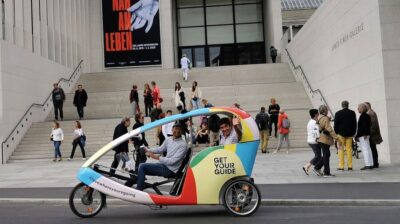
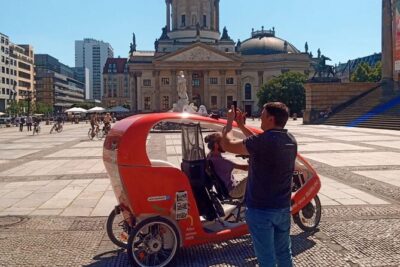
Individual City Tour – Rickshaw Sightseeing in Berlin
Read our review →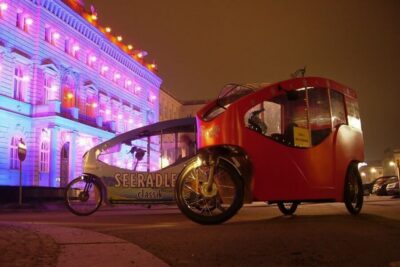

Rickshaw Tours Berlin – Groups of up to 16 people with several rickshaws
Read our review →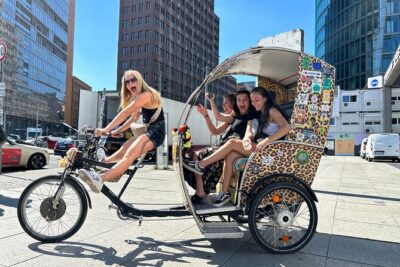
One Up to 3 Rickshaws(6 GUESTS)-Taylor Made Rickshaw Berlin Tour
Read our review →
Berlin Rickshaw Tours Historical & Photo City Tour 120min – Sightseeing
Read our review →Tuk tuk lists that include it