
Review · BERLIN
Rickshaw Tours Berlin – Groups of up to 16 people with several rickshaws
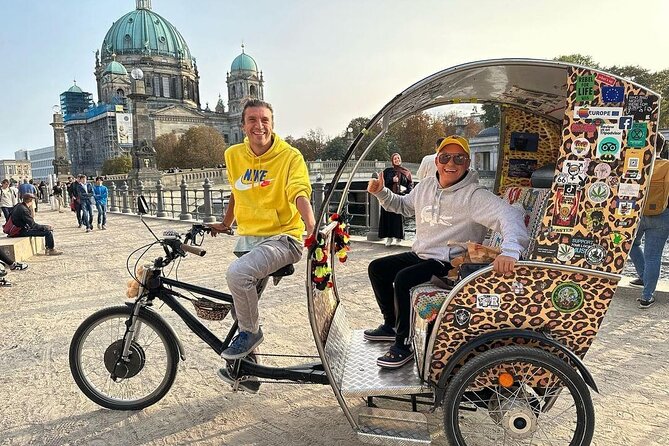
Berlin is a big city with sights spread across several neighborhoods, and this rickshaw tour gives you a quick, low-effort way to connect them. You can roll from the Brandenburg Gate and Reichstag through the Tiergarten, past Checkpoint Charlie, and on to Museum Island without spending the day on foot or in a bus.
I like two things here: the open-air view and the chance to shape the ride around your interests. Guides including Leo and Hugo have earned praise for mixing clear Berlin stories with humor, music, photo stops, and useful food tips. The main concern is reliability. Several bookings ended in no-shows or last-minute cancellations, so this is a tour to confirm carefully and avoid making the only fixed plan of a short Berlin visit.
Key points at a glance
- A fast route through central Berlin: The ride connects the Brandenburg Gate, Reichstag, Tiergarten, Potsdamer Platz, Checkpoint Charlie, Gendarmenmarkt, Museum Island, and Alexanderplatz.
- Private groups up to 16 people: Larger parties use several rickshaws, which keeps the experience private but can mean guides vary in quality.
- Good for tired legs: The rickshaw suits families, older visitors, and people dealing with injuries or mobility limits who still want to see a lot of central Berlin.
- Guides shape the mood: Leo is praised for humor, music, local suggestions, and historical stories. Hugo is praised for photos, flexibility, and strong explanations. Ufuk Ayik has also received praise for working hard in difficult weather.
- Short stops, not museum visits: Most stops last one to five minutes. You see and photograph the sights, but this is not a substitute for entering the Reichstag, museums, or memorial exhibitions.
- Weather and communication matter: The tour requires good weather, and pickup is included only within two kilometers of the Brandenburg Gate. Check the meeting details before you leave.
Why a rickshaw works well in Berlin
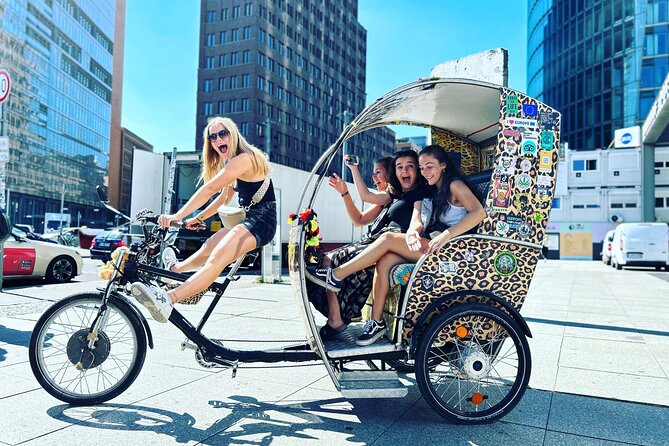
Berlin spreads out in a way that can make sightseeing tiring. The Brandenburg Gate, former Wall sites, Museum Island, and Alexanderplatz are not all next door to one another. A walking tour can cover one section well, but it may leave you short on time for the rest. A bus gives you distance, but less personal contact and a weaker sense of the streets.
The rickshaw sits between those two options. You remain close to the city, hear the guide directly, and get a clear view for photographs. You can also move through the Tiergarten, where a large vehicle would feel clumsy and a long walk can eat up your afternoon.
The tour is private, so your group is not mixed with strangers. Groups can reach 16 people, using several rickshaws. That is useful for families or friends traveling together, though you should understand that multiple vehicles may have different guides and different styles.
The advertised price is $53.10 per person. That is fair if you want a private overview, personal transportation, and a guide in one package. It is less attractive if you mainly want a cheap ride past monuments. The value depends heavily on the guide and the amount of explanation you receive.
More Rickshaw Tours in Berlin:
- Berlin: Private Guided E-Rickshaw Tour
★ 4.9 · 157 reviews - Individual City Tour – Rickshaw Sightseeing in Berlin
★ 5.0 · 120 reviews - Berlin Express: Private 1-Hour E-Rickshaw Ride
★ 5.0 · 116 reviews
From the Brandenburg Gate to the Reichstag
The usual starting point is the Brandenburg Gate, one of Berlin’s clearest symbols. Built from 1788 to 1791 under Carl Gotthard Langhans, it was inspired by the entrance to the Acropolis in Athens. It was meant to finish the grand boulevard Unter den Linden with an impressive architectural gateway.
A rickshaw gives you a useful first look because you can approach the gate at street level and stop for photographs. The planned stop is brief, so do not expect a long architectural talk unless you request one.
The Reichstag, home of the German Bundestag, carries several major chapters of German history. Philipp Scheidemann proclaimed the republic from its west portal in 1918. The building was badly damaged by the 1933 fire, and Soviet soldiers raised a red flag there in April 1945 as Nazi rule collapsed.
The scheduled pause is only about five minutes, and admission is not included. You should think of this as an exterior visit. If you want to enter the glass dome or see the parliament building inside, arrange that separately and do not count on the rickshaw schedule to provide it.
The nearby Federal Chancellery offers a sharp contrast. Its tall central building, glass walls, concrete pillars, and broad openings give it a modern, open appearance. The side wings contain offices arranged around glazed courtyards. Your guide can point out how different this government complex feels from the older monuments nearby.
Tiergarten, tanks, and Potsdamer Platz
The Soviet War Memorial in the Tiergarten is a compact but serious stop. A bronze Red Army soldier carries his rifle in the center, with two T-34 tanks flanking the square. Behind him are pillars bearing the names of Soviet soldiers, and the rear section contains the graves of about 2,500 men.
The memorial is free to see, but the planned stop lasts only three minutes. You will have time to look and take a quick photograph, not to study every inscription. I find this kind of short stop useful as a visual reminder of how close the city’s modern center is to the battles of 1945.
The Tiergarten itself changes the pace. This roughly 200-hectare park began as a hunting ground and became a public pleasure park. Peter Joseph Lenné reshaped it as an English-style public park in the 1830s. Its paths connect monuments, bridges, the Victory Column, the Federal President’s Office, the House of World Cultures, and the English Garden.
This is one of the best parts of the route for the rickshaw. You get greenery, open paths, and a break from traffic without giving up sightseeing. A good driver can make the park feel like part of the tour rather than just a way to get from one monument to another.
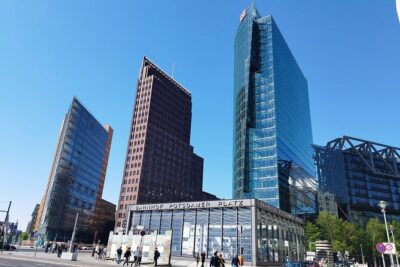
Potsdamer Platz shows a very different Berlin. Once divided and heavily damaged, it was rebuilt as a planned district with high-rise buildings, cinemas, cafés, and shops. The modern complex occupies about 6.8 hectares between Potsdamer Platz and Reichpietschufer.
The stop is only about two minutes. That is enough to get your bearings, but not enough for shopping or a cinema visit. Treat it as a quick contrast between Berlin’s older ceremonial spaces and its rebuilt commercial center.
Nazi history and the Berlin Wall
The Topography of Terror is one of the most important historical sites on this route. From 1933 to 1945, the Secret State Police, the SS leadership, and the Reich Security Main Office operated in this area. It was a central place for planning and directing Nazi crimes.
The outdoor section is free, and the planned stop lasts around five minutes. That gives you a first look at the site, but the exhibition deserves more time if you want to read the documents and understand the institutions involved. I would return independently if this subject matters to you.
The nearby Gropius Bau focuses on cultural history, modern art, and photography. The building itself is worth noticing, but admission is not included and the scheduled pause is just two minutes. The rickshaw can identify it for you, while a separate visit is needed to see an exhibition.
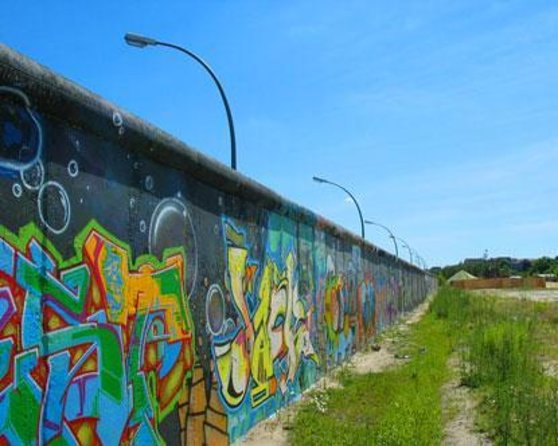
The Berlin Wall Memorial on Bernauer Straße is another place where a short stop can only suggest the full story. This section of the former boundary divided Wedding in the West from Mitte in the East. People attempted dramatic escapes here, including residents who jumped from apartment windows into West Berlin before the buildings were sealed.
The official memorial opened in 1998, and the site preserves sections of the Wall and related spaces. The listed stop is only one minute, so ask your guide for extra time if you want to understand the layout. This is not a site to rush past if the Wall is one of your main reasons for visiting Berlin.
Checkpoint Charlie is more compact and easier to see quickly. It was the best-known American-controlled crossing in divided Berlin and could be used by foreigners, West German officials connected to the permanent representation, and East German officials. The checkpoint has become a familiar image of Cold War Berlin.
The stop lasts about two minutes and is free. The area can feel more commercial and staged than the Wall Memorial, so keep your expectations sensible. It is useful as part of a wider Cold War route, not as the complete story of the division of Berlin.
Friedrichstraße continues the north-south route. After reunification, the stretch between Checkpoint Charlie and Friedrichstraße station became a major shopping street. Your guide can help connect the old border geography with the present-day city.
More tuk tuk tours around Berlin:
- Rickshaw Sightseeing City Tours Berlin – Rikscha Tours
★ 4.0 · 55 reviews - Berlin: Private Sightseeing Tour in an E-Rickshaw
★ 4.9 · 44 reviews - One Up to 3 Rickshaws(6 GUESTS)-Taylor Made Rickshaw Berlin Tour
★ 5.0 · 20 reviews - Daily First Rickshaw promotion in Combi Vehicle public Group 90€
★ 5.0 · 11 reviews
Gendarmenmarkt and Bebelplatz
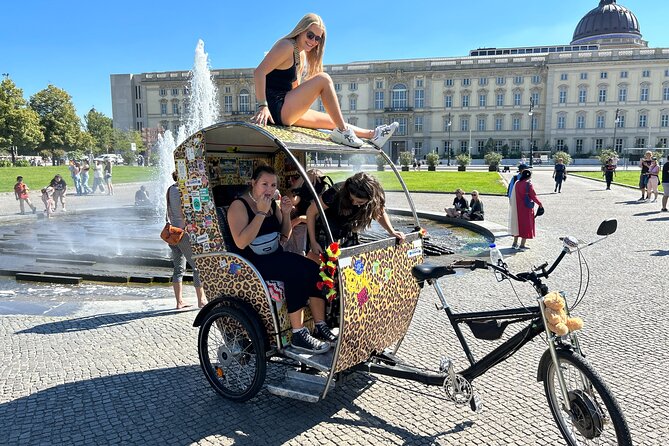
Gendarmenmarkt is one of Berlin’s most handsome squares. It began in the late 17th century and passed through several names before taking its current title in 1799, after the Gens d’armes regiment once stationed here.
The square brings together the German Cathedral, French Cathedral, and Konzerthaus. The planned stop is five minutes and free, making it one of the better places to pause for photographs. If you want to enter any of the buildings, admission and extra time are separate.
The German Cathedral contains the permanent exhibition Ways, wrong paths, detours. It follows the development of liberal parliamentary democracy in Germany across five floors. The tour only allows about two minutes here, so consider this a useful introduction rather than a museum visit.
The Konzerthaus is a major work by Karl Friedrich Schinkel and an important example of classicist architecture. A theater opened here in 1776 under Frederick the Great, and it became the Royal National Theater in 1787. Again, the exterior is the focus unless you plan a separate visit.
Bebelplatz looks elegant, but its memorial marks a dark event. On May 10, 1933, Nazi groups burned more than 20,000 books there, targeting works by writers such as Erich Kästner, the Mann family, Magnus Hirschfeld, Lion Feuchtwanger, Karl Marx, and Else Lasker-Schüler.
A window set into the pavement reveals empty shelves below ground. The brief stop is free and gives you time to see the memorial, though the subject deserves a quiet moment. I appreciate that the route does not present Berlin as only grand buildings and pleasant parks. It keeps the city’s difficult past in view.
Museum Island, the cathedral, and Alexanderplatz
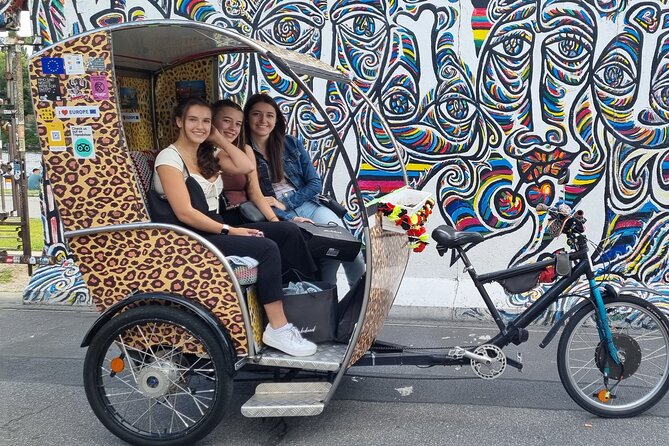
Museum Island occupies the area between the Spree and the Kupfergraben. Its museums hold archaeological collections and 19th-century art, and the group of buildings began with Schinkel’s Old Museum in 1830.
The rickshaw can bring you close to the island without asking you to cross the city on foot. The listed stop lasts five minutes, and admission is not included. If you want to see the Pergamon collection, the Neues Museum, or another museum, set aside a separate block of time.
Berlin Cathedral dominates the nearby view with its large dome. Inside, it is heavily decorated, and climbing to the dome gallery gives views across the city center, the Spree, Lustgarten, and Museum Island. The scheduled pause is only one minute, so the rickshaw offers a quick exterior look rather than a cathedral visit.
Lustgarten sits between the cathedral, the Old Museum, Karl-Liebknecht-Straße, and the Kupfergraben. Two rows of linden trees and a large red granite bowl frame the open space. In warm weather, the lawns and fountain make it a pleasant place to pause after the ride.
The final major sight is Alexanderplatz, known locally as Alex. It has been a busy public square from the 1920s through the East German period and into the present day. The television tower, World Clock, Friendship Fountain, shops, and transport connections all gather here.
The stop is about one minute, so it is best used as a final orientation point. If your pickup began elsewhere, the activity returns to its starting meeting point at the Brandenburg Gate. Alexanderplatz is not the endpoint unless your private route is adjusted in advance.
Guides, music, and the quality of the ride
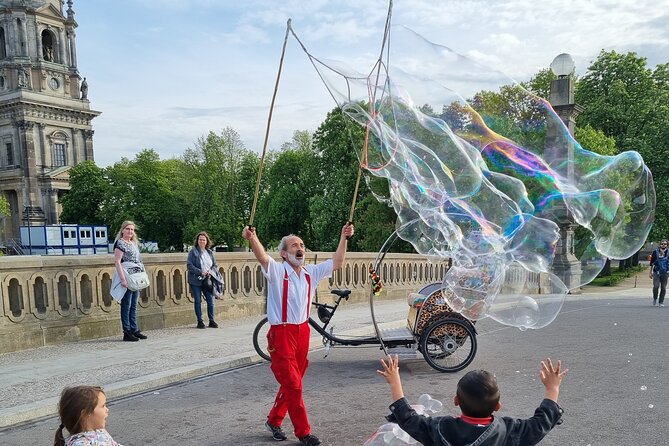
The guide can make or break this experience. Leo receives especially strong praise for his humor, music, historical stories, food and drink suggestions, and ability to make the city feel personal. He has also been helpful to people recovering from running injuries or bicycle accidents, using the rickshaw as an easier alternative to a walking tour.
Hugo is praised for explaining Berlin’s past, asking what you want to see, allowing time for photographs, and taking pictures of the group. Ufuk Ayik has been recognized for staying accommodating in harsh weather. These details matter because the route itself is familiar, while the guide determines how much meaning you take from it.
Music is available on request. That can add a fun party feel, but it should not drown out the guide. One poor experience involved music played too loudly, making the spoken explanation hard to hear. Ask for the volume to stay low enough for conversation.
A separate concern is driving. One account describes a rough maneuver and contact with a van. I would expect careful driving from any city tour, and if the ride feels too fast or abrupt, say so at once.
Group size, pickup, weather, and reliability

Pickup is included within two kilometers of the Brandenburg Gate. Beyond that, the stated charge is €10 per kilometer. The main meeting point is the Brandenburg Gate, and the ride returns there at the end.
The activity lasts approximately one to four hours. That broad range suggests a flexible private outing rather than one fixed route. A one-hour version will be a quick circuit with exterior views. A longer booking gives you more time for photos, commentary, and selected stops, though the full list of sights still cannot be explored in depth in a short ride.
The tour includes private transportation, onboard Wi-Fi, a tour guide, a photographer, and music on request. Alcoholic drinks are not included. Service animals are allowed, and the activity is near public transportation.
The biggest practical warning is the record of missed departures and cancellations. Some bookings had no guide appear, with people waiting in the cold or rain and trying to reach the operator without success. Other cancellations were linked to illness, lost equipment, or cold-weather battery problems. The operator has apologized for these failures, but the pattern is important enough to affect your decision.
Book with free cancellation at least 24 hours before the start time if your plans may change. The experience requires good weather, and a weather cancellation should result in another date or a full refund. I would confirm the meeting point and phone contact shortly before departure, and I would not schedule this as the only activity on a day when you have a train or flight to catch.
Who should book the Berlin rickshaw tour?
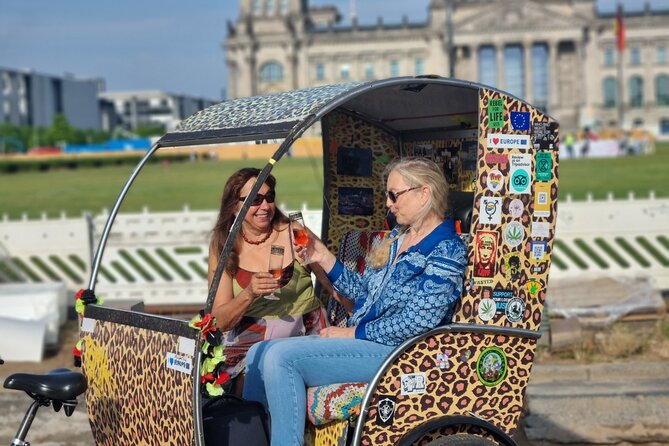
I would choose this for a first look at Berlin, a private family outing, or a group that wants to cover ground without a long walk. It is also a sensible option if someone in your party has a temporary injury or limited stamina. The low seating position and open sides offer a much more direct view than a coach.
It suits people who like stories, photos, and a relaxed city ride more than people seeking long museum visits. You can see a lot, but you will not study every memorial or enter every building.
Should you book it?
Book this tour if you value a personal guide, want a quick orientation of central Berlin, and can keep your schedule flexible. Leo and Hugo appear to offer the best combination of humor, useful information, photography, and local suggestions.
I would be cautious if dependable timing is essential. The no-show and cancellation problems are too serious to ignore, especially if you have only one day in Berlin. Confirm the booking, keep a backup plan, and ask for a clear pickup time. With a reliable guide, the rickshaw is a pleasant and efficient way to connect Berlin’s major sights. Without one, the convenience disappears quickly.
FAQ
How long does the Berlin rickshaw tour last?
The activity lasts approximately one to four hours. A shorter booking works as a quick overview, while a longer booking allows more time for commentary, photographs, and selected stops.
Where does the tour begin and end?
The main meeting point is the Brandenburg Gate in Berlin. The activity ends back at the meeting point.
Is hotel pickup available?
Pickup is included within a two-kilometer radius of the Brandenburg Gate. Pickup beyond that distance costs €10 per kilometer.
How many people can join the tour?
The tour is private and can accommodate groups of up to 16 people using several rickshaws.
Are admission tickets included?
No. Admission is not included for places such as the Reichstag, Gropius Bau, the Berlin Wall Memorial, the German Cathedral, the Konzerthaus, Museum Island, and Berlin Cathedral. Several outdoor stops are free.
What happens if the weather is poor?
The experience requires good weather. If the operator cancels because of poor weather, you should be offered another date or a full refund.
Newly added rides around Berlin
- Romantic Berlin Rickshaw City and Photo Tour – incl. pick-up★ 4.0 · 9 reviews
- Rickshaw Sightseeing Tours Berlin – Highlights Berlin – Rickshaw city tour★ 3.5 · 3 reviews
- One Up to 3 Rickshaws(6 GUESTS)-Taylor Made Rickshaw Berlin Tour★ 5.0 · 20 reviews
- Rickshaw Tour-Cruise Ship guests arrive 9.30 upto 11.30 am Berlin★ 5.0 · 7 reviews
- Daily First Rickshaw promotion in Combi Vehicle public Group 90€★ 5.0 · 11 reviews
- Private Guide Up to Group 6 – ONE Rickshaw, (E)Bikes, E-Scooters★ 5.0 · 3 reviews
- Rickshaw Sightseeing City Tours Berlin – Rikscha Tours★ 4.0 · 55 reviews
- Private Up to 12 Guests-ONE RICKSHAW, E-Bikes, E-Scooters★ 5.0 · 2 reviews
Berlin Tuk Tuk Tours: the nearest alternatives
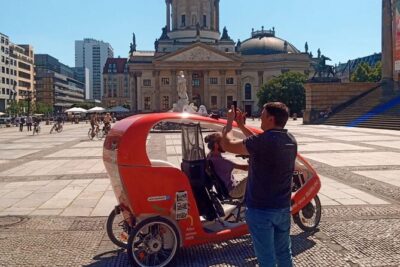
Individual City Tour – Rickshaw Sightseeing in Berlin
Read our review →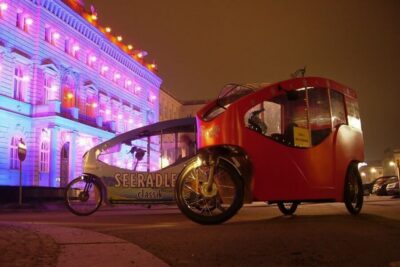
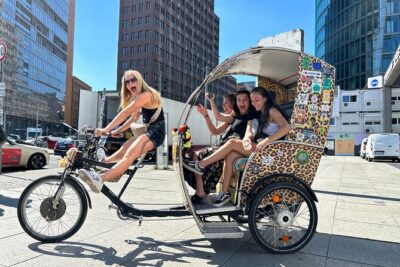
One Up to 3 Rickshaws(6 GUESTS)-Taylor Made Rickshaw Berlin Tour
Read our review →
Berlin Rickshaw Tours Historical & Photo City Tour 120min – Sightseeing
Read our review →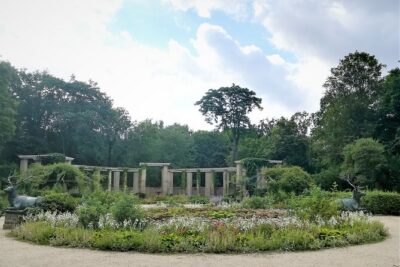
Daily First Rickshaw promotion in Combi Vehicle public Group 90€
Read our review →Tuk tuk lists that include it