
Review · BERLIN
Promotion Berlin Rickshaw Shared Guide (Combo Vehicle Group)
Berlin’s historic centre spreads across a large area, and a rickshaw lets you cover it without wearing out your feet. Over 210 minutes, you move between Alexanderplatz, Museum Island, Checkpoint Charlie, the Holocaust Memorial, Brandenburg Gate, and the Reichstag while your guide handles the pedaling and explains what you are seeing.
I like two things right away. The route is efficient, giving you a clear first look at many major sights in one outing. I also like the photo-friendly pace, with regular stops and a guide who can help find useful angles. Levent, named in one recent booking, was praised for keeping the tour informative and fun, even on a very hot day.
The main drawback is simple: you are outside for nearly four hours, so weather matters. A rickshaw makes sightseeing easier, but it does not replace a coat in winter or sun protection in summer. One recent guest received blankets in cold weather, yet still advised dressing for the conditions.
Key Points Before You Book
- A three-and-a-half-hour route through Berlin Mitte: You see the city’s main historic sights without trying to walk the whole centre.
- A guide-powered ride: Your guide pedals, drives, explains the city, and handles the route while you sit back.
- Photo stops at major landmarks: You have time to take pictures at places such as the Berlin Cathedral, Checkpoint Charlie, Brandenburg Gate, and the Reichstag.
- Useful for limited mobility: You can bring a walker, and the rickshaw can bring you close to monuments without requiring long walks between them.
- A booking for up to two people: The quoted price is $235 per rickshaw for two, with the wider activity limited to six people.
- Flexible language choices: Tours are offered in English, German, Dutch, or Turkish.
Starting at Rosenthaler Platz
The meeting point is Weinbergsweg 6, near U-Bahn Rosenthaler Platz in Berlin’s Mitte district. This is a handy place to begin because it feels like a real part of central Berlin rather than a tour-bus parking area.
Rosenthaler Platz has cafes, bars, shops, public transport, and plenty of street activity. Nearby Weinbergsweg leads toward Weinbergspark, a small green space where you can pause before or after the ride. If you arrive early, you can grab a coffee or use the surrounding shops and cafes to get settled.
The exact meeting point matters in Berlin. The city centre is easy to reach, but the sights are spread out and the streets can be confusing if you are seeing them for the first time. Arrive with enough time to locate Weinbergsweg 6 rather than relying on a last-minute dash from the station.
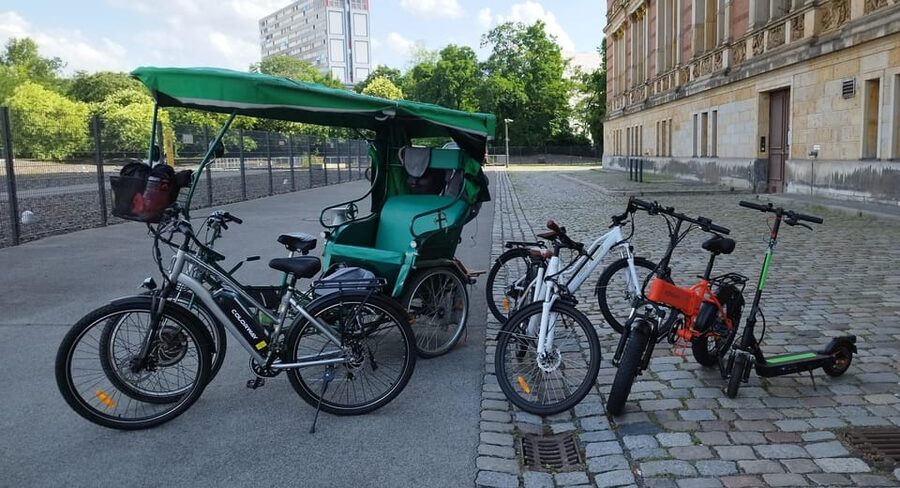
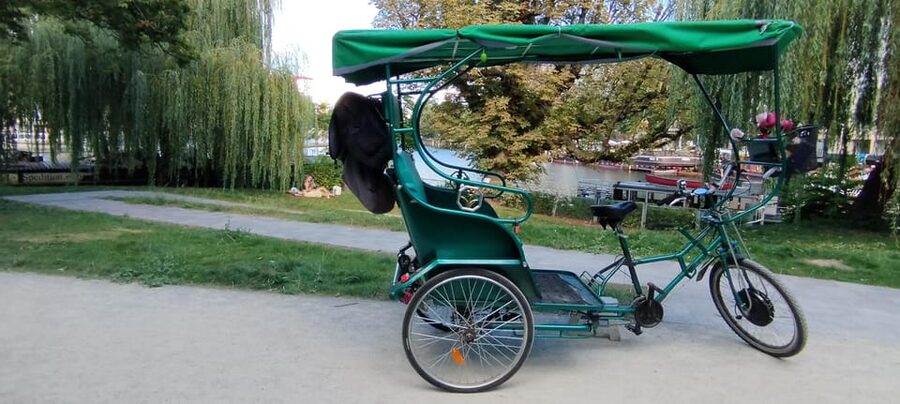
The vehicle is a traditional rickshaw, operated by the guide. You are not expected to pedal. That makes this a useful option if you cannot cycle, do not want to cycle, or simply prefer to spend your energy looking at the city.
More Rickshaw Tours in Berlin:
- Berlin: Private Guided E-Rickshaw Tour
★ 4.9 · 157 reviews - Individual City Tour – Rickshaw Sightseeing in Berlin
★ 5.0 · 120 reviews - Berlin Express: Private 1-Hour E-Rickshaw Ride
★ 5.0 · 116 reviews
Why a Rickshaw Works Well in Berlin
Berlin is not a compact old town where every famous sight sits around one square. Alexanderplatz, Museum Island, the government quarter, Checkpoint Charlie, and the former Wall sites require a fair amount of movement between them.
A walking tour can give you more time at individual monuments, but it also means covering many streets on foot. A bicycle tour is quicker, though it requires confidence in city traffic and enough physical ability to keep going. The rickshaw takes the middle path: you move efficiently, stay close to the street, and let the guide do the physical work.
The route can use bicycle roads, parks, and squares. That gives you a street-level view without the enclosed feeling of a bus. You can watch Berlin change from busy commercial streets to formal boulevards, memorial spaces, government buildings, and former Cold War checkpoints.
This format is especially practical for a first day in Berlin. You get a map in your head, identify the places you want to revisit, and learn which sights deserve more time later. It is not a substitute for entering museums or spending an hour at each memorial. It is a strong orientation tour with many stops.
Alexanderplatz and Berlin’s Changing Face
The ride begins with Alexanderplatz, one of Berlin’s best-known public squares. It is a useful opening stop because the area shows how dramatically the city has changed over time.
You can expect a guided look at the square, with time for pictures and views along the way. The guide can place the broad urban setting in context, then move you onward without the need to linger in a large, open space.
Alexanderplatz is not the prettiest part of Berlin, and that is part of its value. Its wide spaces, modern buildings, and famous television tower reflect the city’s East German past and later redevelopment. If you expect a preserved medieval square, adjust those expectations. This is a place to see Berlin’s modern and political layers rather than an old European postcard.
Berlin Cathedral and Museum Island
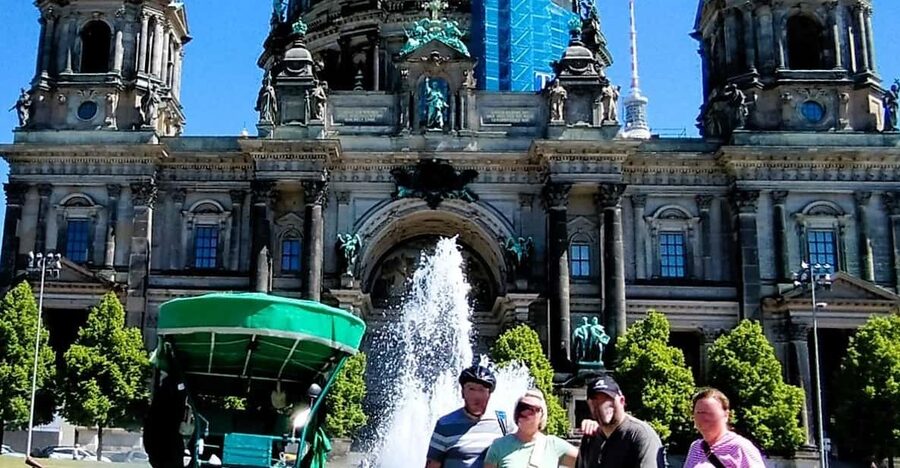
The route continues to Berlin Cathedral and Museum Island. These are among the most rewarding visual sections of the tour, especially if you enjoy grand architecture.
At the cathedral, you get a photo stop and a guided explanation from outside. The building’s dome and riverside setting make it easy to photograph, and the rickshaw can bring you close without forcing you to cross large distances on foot.
Museum Island sits at the heart of Berlin’s cultural centre. The tour gives you a useful look at the island’s buildings and location, but museum entry is not listed as part of the experience. If you want to visit the Pergamon Museum, the Neues Museum, or another collection, plan a separate visit and allow much more time.
This is one of the places where the rickshaw format works best. You can see the sweep of the complex, hear how the buildings fit into Berlin’s story, and mark it for a later visit without spending your entire day indoors.
More Guided Tours around Berlin:
- Private Guide Up to Group 6 – ONE Rickshaw, (E)Bikes, E-Scooters
★ 5.0 · 3 reviews - Rickshaw for 2 and Driver-Shared Guide (Combo Vehicle Group)
★ 5.0 · 2 reviews - Porto: Guided Tour by Tuk-Tuk & Optional Douro River Cruise
★ 4.5 · 5,980 reviews - Lisbon: Private Guided Tuk-Tuk Tour with Hotel Pickup
★ 4.9 · 4,552 reviews
Unter den Linden and the Book-Burning Memorial
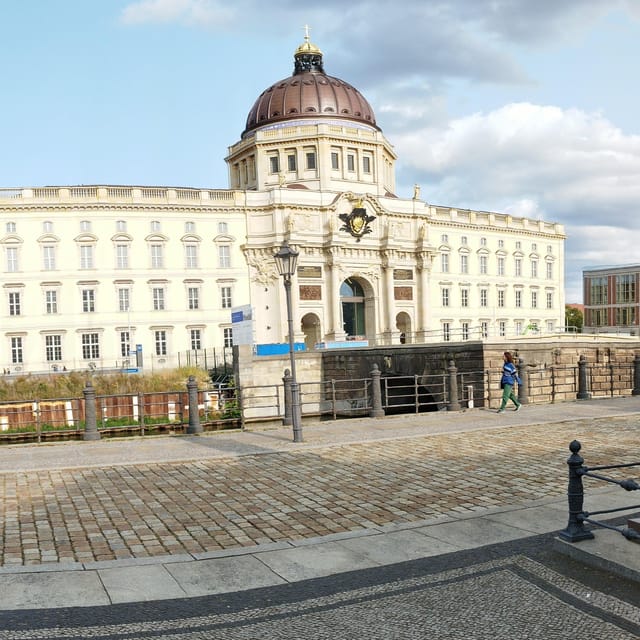
From Museum Island, the route follows Unter den Linden, Berlin’s famous grand boulevard. This is a fine stretch for watching the city pass by. You see formal buildings and broad avenues while the guide connects them to Berlin’s royal, political, and modern history.
The tour also stops at the memorial to the Nazi book burning of May 10, 1933. This is a small but serious site, and the guide’s explanation matters because the memorial can be easy to miss if you are simply walking along the boulevard.
The stop is not about spectacle. It points to the destruction of books and ideas under the Nazi regime, making it one of the tour’s quieter and more reflective moments. Give yourself time to listen rather than treating every stop as a quick photograph.
Checkpoint Charlie and the Topography of Terror
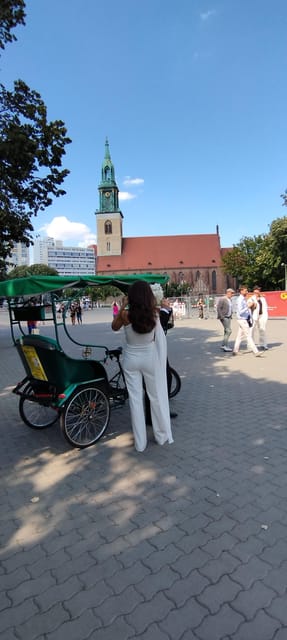
Checkpoint Charlie is one of Berlin’s most recognizable Cold War locations. The rickshaw brings you into the former border area for a guided stop and photographs.
The setting today is busy and commercial, so it helps to know what you are looking at. This is not an untouched border crossing. It is a historic location surrounded by modern businesses and tourism. The value comes from the guide’s explanation of the former division of Berlin and the meaning of the checkpoint, not from expecting an original Cold War scene.
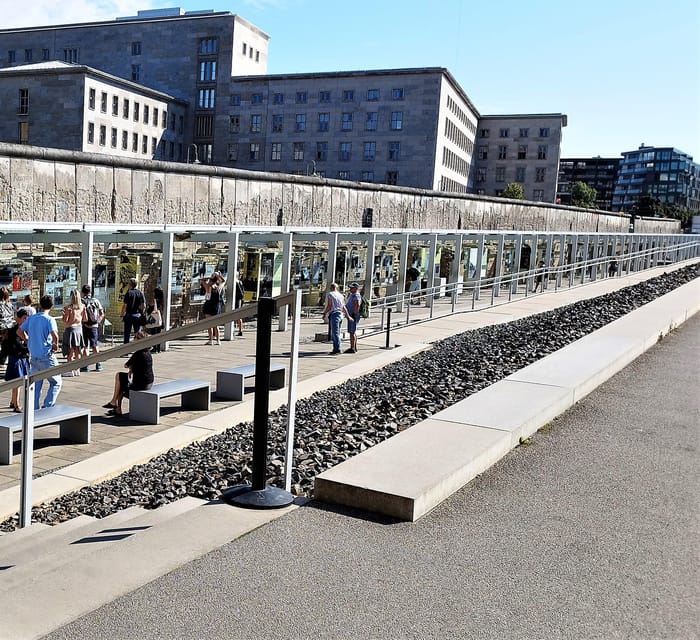
The nearby Topography of Terror adds a different layer. This documentation centre focuses on Nazi persecution and the institutions that carried it out. The tour includes a guided stop, but the activity does not include an extended indoor visit.
You can use the rickshaw ride to understand where the site is, then return on your own if you want to read the displays in detail. That division of time is sensible. A short stop gives you the setting, while a separate visit lets you absorb the material without watching the clock.
Hitler’s Bunker and the Weight of Difficult History
The route passes the location associated with Hitler’s bunker. There is no grand structure to see. The site is deliberately plain, and the surrounding city has changed.
That can make the stop feel underwhelming if you arrive expecting a preserved ruin or a dramatic marker. Its purpose is to explain the location and the final days of the Nazi regime, not to provide a conventional monument.
I appreciate that this part of the route keeps the focus on historical context rather than spectacle. Berlin’s central sights often place beautiful buildings beside reminders of violence and dictatorship. A good guide helps you understand those contrasts without turning the subject into entertainment.
The Holocaust Memorial
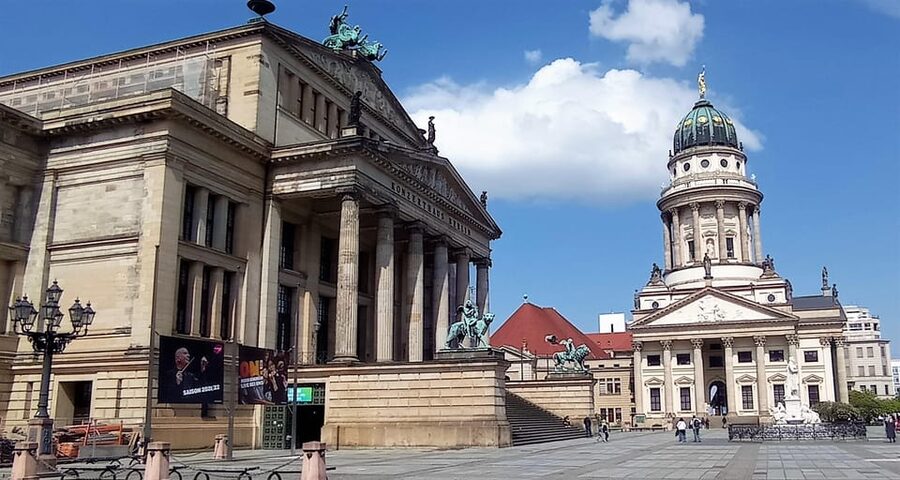
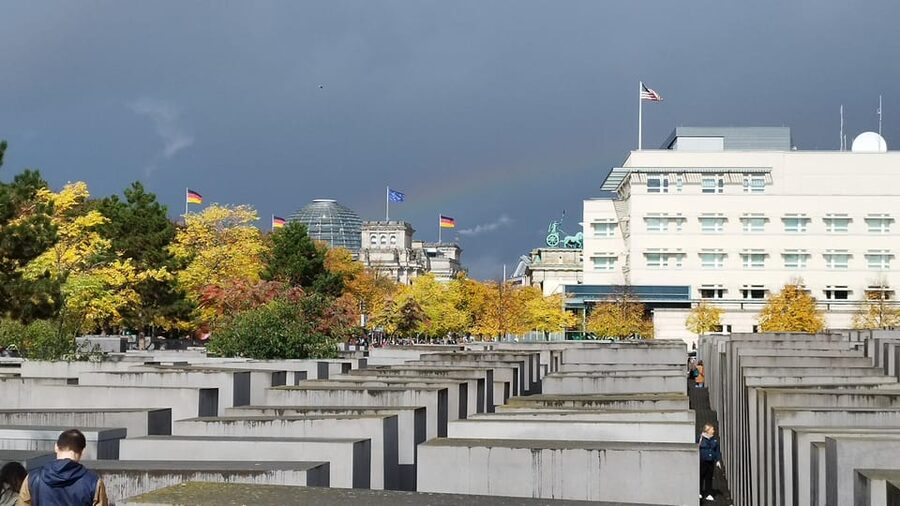
The Holocaust Memorial is one of the tour’s most important stops. Its field of concrete blocks creates a changing sense of scale as you move around it, and the open layout invites a quiet pause.
You receive a guided visit and time for photographs. Still, photography should not be the only purpose here. The memorial deserves a respectful approach, and the guide can explain its role in remembering the Jewish victims of the Holocaust.
A rickshaw is useful because it brings you close to the site and reduces the walking needed between other landmarks. You may want to get out and move among the blocks, but the experience is also designed for people who cannot walk far. The vehicle can remain part of the visit if you prefer not to step out.
Brandenburg Gate and the Reichstag
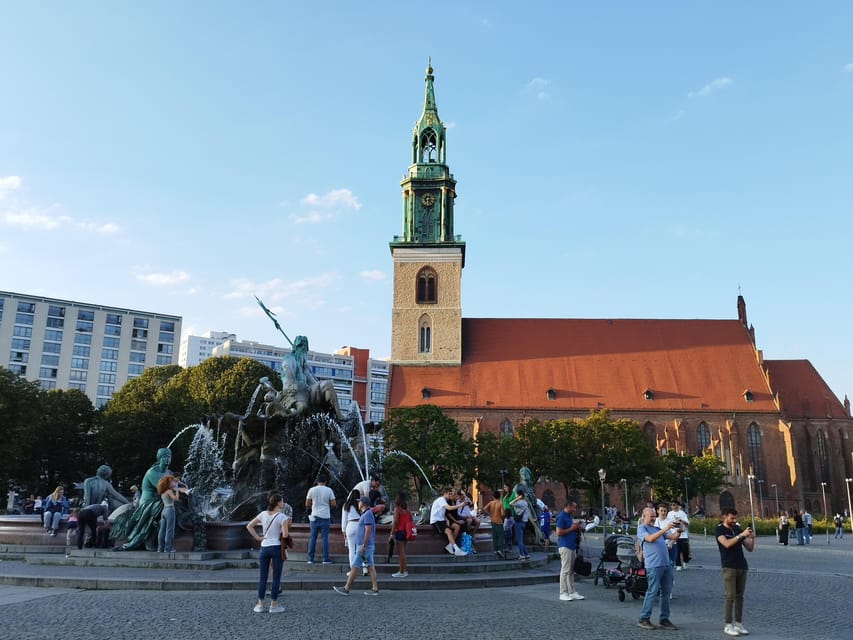
The final major section reaches Brandenburg Gate and the Reichstag. These are the images most people associate with central Berlin, and the rickshaw gives you time to see both without negotiating a long route on foot.
Brandenburg Gate works well as a photo stop. It is large, open, and easy to recognize, but the guide adds meaning by explaining its place in Berlin’s political story and its role during the city’s division and reunification.
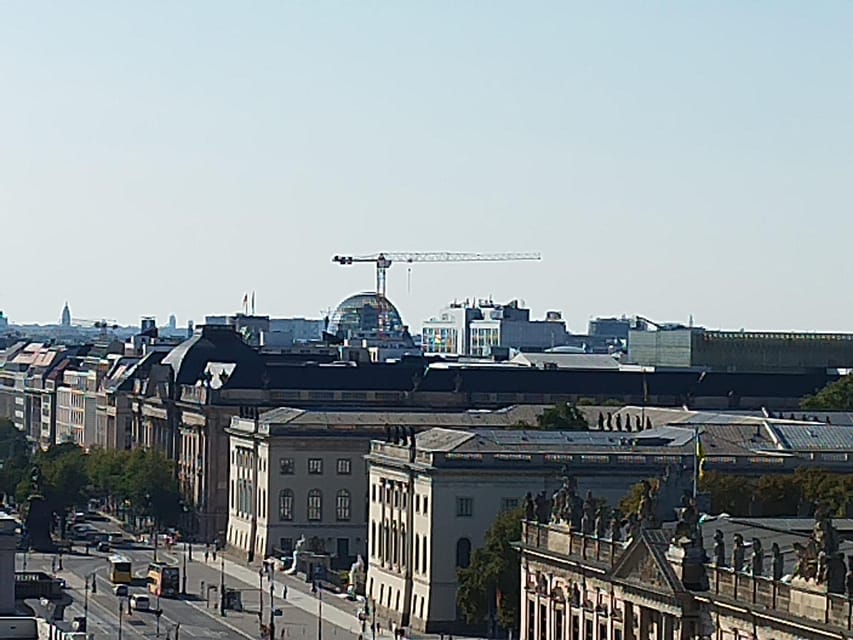
The Reichstag, home of Germany’s federal parliament, is another strong exterior stop. You can photograph the building and hear about its role in modern Germany. Entry inside is not included, so do not confuse this tour with a Reichstag visit. If you want to see the dome, you will need to arrange that separately.
This final stretch gives the outing a satisfying shape. You begin with Alexanderplatz and Berlin’s eastern city centre, then cross through memorials and Cold War sites before ending among the main symbols of German government and reunification.
The Guide Makes the Difference
The guide is not just a driver. The service includes an experienced guide who pedals, navigates, provides commentary, answers questions, and helps with photographs.
The guides are described as certified under DIN EN 15565, and tours are available in English, German, Dutch, or Turkish. That language choice is useful for a tour with so much historical explanation. Ask questions as you go, especially at places where the physical setting does not explain much on its own, such as the bunker location or Checkpoint Charlie.
Levent received particular praise for pedaling for three hours in hot weather, explaining the sights clearly, and making room for requested photo stops. Another recent guest said the guide knew good angles for pictures and helped create an easy pace. Those details are important because the quality of the ride depends heavily on the person operating it.
The photo help is a pleasant extra. The guides are described as strong photographers, so you can ask for a picture at major stops instead of relying only on selfies. The service also includes free water and soft drinks. Beer or sparkling wine may be enjoyed in the rickshaw, but drink responsibly and remember that the guide is working.
Comfort, Weather, and Mobility
This is a sit-down sightseeing experience, but it is still an outdoor activity. In cold weather, blankets may be provided, though you should still wear warm clothes. In hot weather, bring sun protection and drink water. The tour includes free water and soft drinks, but personal preparation still matters.
The rickshaw can carry a walker, which makes the experience useful for people with limited mobility. You can also get close to monuments without walking from one attraction to the next. That does not mean every stop is fully step-free or that you never need to leave the vehicle. Ask the provider about your specific mobility needs before booking if you require detailed assistance.
Families and small parties may also like the format. The booking is for one rickshaw and up to two people, while the broader activity is limited to six participants. The price is therefore not a per-person bargain for a solo visitor, but it becomes easier to justify when two people share the vehicle.
Is $235 Good Value for Two?
At $235 per group of up to two, this is a premium city tour. You are paying for a private rickshaw booking, a guide and driver, a long central route, photo stops, and the ability to avoid much of the walking between sights.
The value improves if you have limited mobility, want a private outing, or have only one day to get oriented. It also makes sense for two people who would otherwise spend money on separate transport and a guided walking tour.
The price is harder to justify if you mainly want to visit museums or spend long periods inside each historic site. Admission is not included, and the tour moves on after its guided stops. In that case, use the rickshaw as an overview and save your museum time for another day.
There is only one promotional rickshaw available each day, according to the supplied details. That makes advance planning sensible, particularly if you need a specific language or travel date. Free cancellation up to 24 hours ahead and the option to reserve now and pay later make the booking less risky, but the limited daily availability may narrow your choices.
Who Should Book This Ride?
I would point this tour toward:
- People who want to see Berlin’s main historic sights in one outing
- Couples or friends who prefer a private rickshaw for two
- Visitors who cannot or do not want to cycle
- People with limited mobility who want shorter distances between landmarks
- First-time visitors who need a clear orientation to Berlin Mitte
- Families who value a flexible pace and frequent photo stops
I would choose another format if your main goal is a long museum visit, a focused study of one period, or a quiet walking tour with extended time at each memorial. The rickshaw is built for coverage, comfort, and explanation on the move.
Should You Book It?
Book this Berlin rickshaw tour if you want a comfortable overview of the centre and do not want to spend half your day walking between far-flung sights. The route covers an impressive set of landmarks, and the combination of guide commentary, photo stops, and close access is particularly useful for less mobile visitors.
Think carefully about the price if you are traveling alone or plan to revisit every stop at length. For two people who value convenience, a personal guide, and a gentle way to reach Berlin’s major historic sites, $235 can be fair. Dress for the weather, arrive at Weinbergsweg 6 prepared to sit outside, and treat the ride as your first look at Berlin rather than your only visit to its museums and memorials.
FAQ
How long does the Berlin rickshaw tour last?
The activity lasts 210 minutes, or three and a half hours. The route covers Berlin Mitte and returns to Weinbergsweg 6.
Where does the tour start and finish?
The tour starts and finishes at Weinbergsweg 6, near U-Bahn Rosenthaler Platz in Berlin.
What sights are included?
The route includes Alexanderplatz, Berlin Cathedral, Museum Island, Unter den Linden, the memorial to the May 10, 1933 Nazi book burning, Checkpoint Charlie, the Topography of Terror, Hitler’s bunker location, the Holocaust Memorial, Brandenburg Gate, and the Reichstag.
How many people can the booking accommodate?
The quoted price covers one rickshaw for up to two people. The activity is described as a small group limited to six participants.
Which languages are available?
Live guiding is available in Dutch, English, German, and Turkish.
Is the tour suitable for someone with limited mobility?
The rickshaw is intended for people who cannot or do not want to cycle, and a walker can be taken along. The vehicle can also bring you close to monuments, reducing the distance between stops.
Newly added rides around Berlin
- Romantic Berlin Rickshaw City and Photo Tour – incl. pick-up★ 4.0 · 9 reviews
- Rickshaw Sightseeing Tours Berlin – Highlights Berlin – Rickshaw city tour★ 3.5 · 3 reviews
- One Up to 3 Rickshaws(6 GUESTS)-Taylor Made Rickshaw Berlin Tour★ 5.0 · 20 reviews
- Rickshaw Tour-Cruise Ship guests arrive 9.30 upto 11.30 am Berlin★ 5.0 · 7 reviews
- Daily First Rickshaw promotion in Combi Vehicle public Group 90€★ 5.0 · 11 reviews
- Private Guide Up to Group 6 – ONE Rickshaw, (E)Bikes, E-Scooters★ 5.0 · 3 reviews
- Rickshaw Sightseeing City Tours Berlin – Rikscha Tours★ 4.0 · 55 reviews
- Private Up to 12 Guests-ONE RICKSHAW, E-Bikes, E-Scooters★ 5.0 · 2 reviews
Berlin Tuk Tuk Tours: the nearest alternatives
Individual City Tour – Rickshaw Sightseeing in Berlin
Read our review →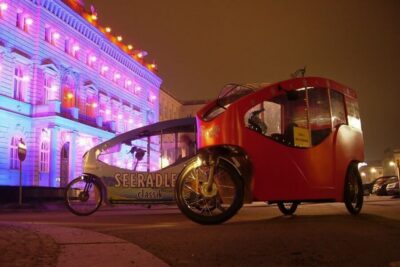

Rickshaw Tours Berlin – Groups of up to 16 people with several rickshaws
Read our review →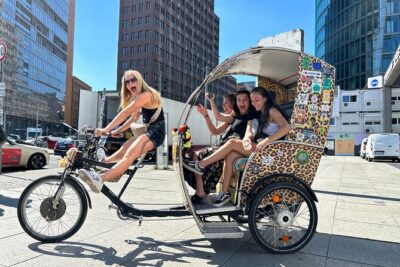
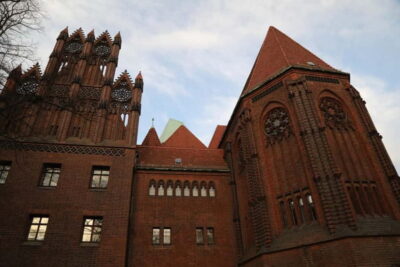
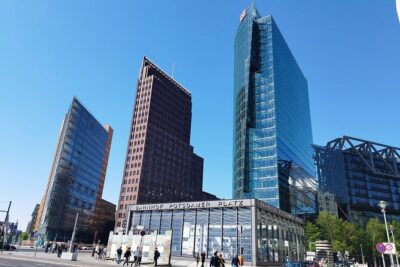
One Up to 3 Rickshaws(6 GUESTS)-Taylor Made Rickshaw Berlin Tour
Read our review →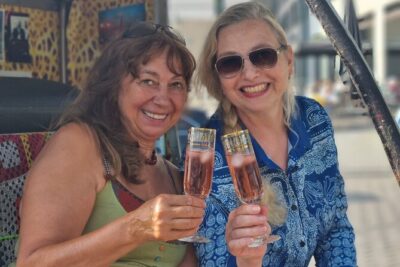
Berlin Rickshaw Tours Historical & Photo City Tour 120min – Sightseeing
Read our review →Tuk tuk lists that include it