
Review · TOKYO
Tokyo Asakusa Rickshaw Tour
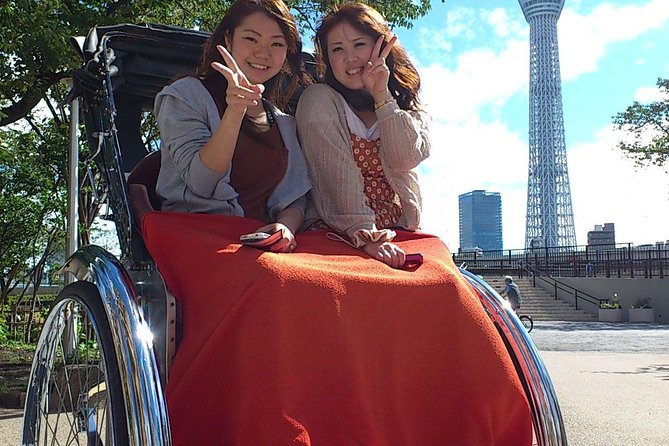
Asakusa is one of the few parts of Tokyo where a rickshaw ride can take you from a Shinto shrine with cat figurines to an Edo-era street, then across the Sumida River for a clear view of Tokyo Skytree. The ride gives you a slower, street-level look at old Tokyo, with a guide doing the pedaling and explaining what you see.
I like the flexible route and the personal attention. You can ask for photo stops, shrines, gardens, or entertainment history, and guides such as Koko, Micchy, Kei, and Takumi are known for friendly conversation and useful local advice. The main drawback is space: one rickshaw is only 74 centimeters wide, so two adults sit close together.
Key points to know before booking
- Choose from 30 minutes to three hours: Short rides cover a small slice of Asakusa, while longer options can include several shrines, old streets, parks, and river views.
- Request your interests: Tell the guide if you care most about temples, Shinto customs, photography, Edo-era buildings, anime locations, or local entertainment history.
- Expect a private ride: Only your group takes part, with a maximum of two adults per rickshaw.
- Plan for a snug seat: Two adults fit, but separate rickshaws may be more comfortable for larger passengers.
- Look for special local details: Ushijima Shrine has a three-entrance gate, Honryuin Matsuchiyama Shoden features radishes, and Imado Shrine is filled with beckoning cats.
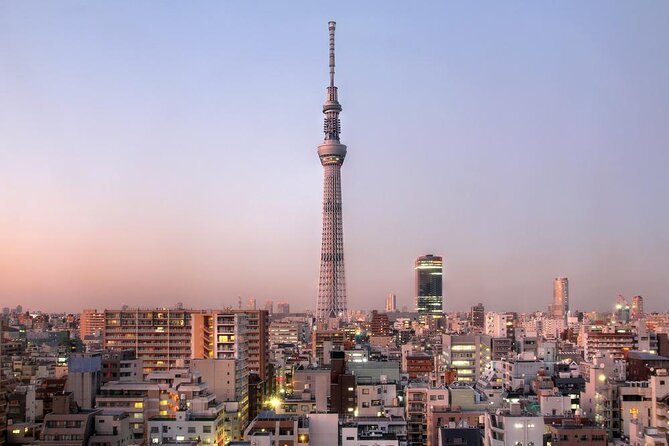
- Keep your camera ready: The Sumida River and Tokyo Skytree provide one of the best photo stops in the area.
Why a rickshaw works so well in Asakusa
Asakusa is easy to visit on foot, but it is also spread across a busy mix of temple grounds, narrow streets, shopping lanes, parks, old theaters, and riverside viewpoints. A rickshaw helps you cover more ground without turning the visit into a march.
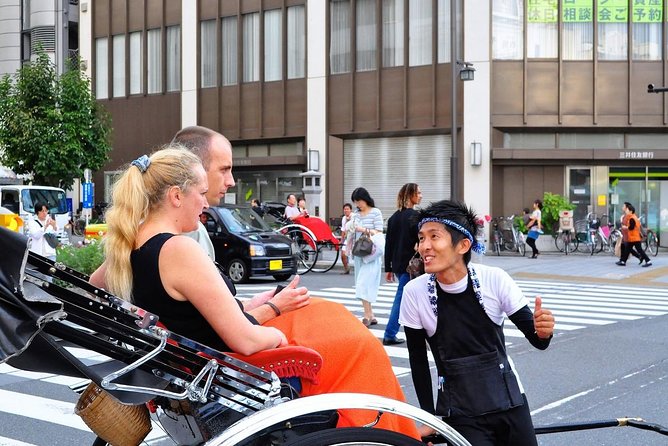
You sit above street level, close enough to notice shop fronts and small details, while the guide handles the traffic and route. That makes the ride feel more personal than a bus tour. You can ask questions as you go, and the guide can stop to point out a gate, statue, building, or local custom.
The ride is also a useful first activity in Asakusa. A 30 or 45-minute option can help you get your bearings before you return on foot. A two or three-hour option feels more like a proper neighborhood tour and gives the guide room to follow your interests.
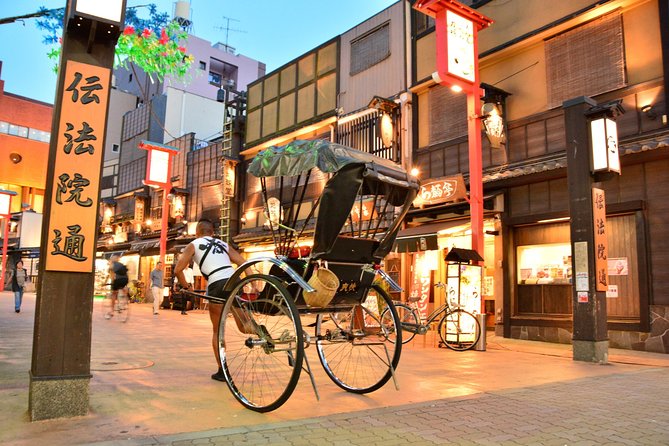
The route is not fixed. You might pass old housing facades, a raccoon-themed street, Hanayashiki, the Asahi Beer Headquarters, Sumida Park, or the entertainment district around Rokku Street. The exact mix depends on your time and the route you discuss with the driver.
More Rickshaw Tours in Japan:
- Kyoto: Arashiyama Customized Rickshaw Tour & Bamboo Forest
★ 5.0 · 432 reviews - Kyoto Arashiyama Rickshaw Tour with Bamboo Forest
★ 5.0 · 354 reviews - Kyoto Rickshaw Tour
★ 5.0 · 210 reviews
Starting outside Asakusa Station
You make your own way to 1-chōme-1-4 Asakusa, near Asakusa Station. The meeting point is close to public transportation, and confirmation is provided when you book. Look for the rickshaw stand and allow a little extra time to find it, especially if Asakusa is new to you.
Once you meet the guide, explain what you want to see. This matters more on a short ride. If you have only 30 minutes, you will not cover every place listed for the longer route. Ask in advance, or speak directly with the guide, so the route matches your priorities.
The tour is private, which is a real advantage. You do not have to wait for a large group or listen to questions unrelated to your visit. The guide can adjust the pace, suggest a drop-off point, and take photos at selected stops.
English and Japanese-speaking drivers are available subject to availability. Select your preferred language when booking, but understand that the exact guide is not guaranteed. Guides who have led rides include Koko, Micchy, Kei, Takumi, Nene, Yusuke, Taisei, BUCHI, and Kazumasu-san. The strong pattern among the guide feedback is clear: humor, energy, cultural explanations, and a willingness to take good photographs matter as much as the ride itself.
Old streets, raccoons, and Tokyo entertainment
The early part of the route can show you a side of Asakusa that is easy to miss between the major sights. One historic street has shop fronts and housing facades that recall the Edo period. You are not seeing a preserved museum set, but an active part of the neighborhood where older design survives beside modern Tokyo.
Another street has raccoons as its theme, with figurines placed every few meters. It is a small, quirky stop rather than a major monument, but it gives the ride personality. This is the sort of detail a driver can point out while you are moving between larger attractions.
You may also pass Hanayashiki, one of Japan’s oldest amusement parks still in operation. Its presence fits Asakusa perfectly. The neighborhood mixes religious sites, old entertainment, family attractions, and everyday businesses without trying to separate them into tidy zones.
Rokku Street adds another layer. Before the war, it was Tokyo’s leading entertainment district, filled with cinemas and theaters. Today it is part of Asakusa’s retro district. If you enjoy old theater history or want more than temples and photographs, tell your guide to include this area.
The tour can also pass a venue tied to Japanese comedy and live shows. The exact stops depend on the duration and route, but these entertainment sites help explain why Asakusa has long been a place for leisure, not only worship.
Ushijima Shrine and its unusual gate
Ushijima Shrine is one of the main stops on the longer routes. It is a Shinto shrine, and the guide explains why its gate has three entrances instead of the standard single entrance.
That detail makes the stop more rewarding than a quick photo. Japanese religious architecture often carries meaning in its layout, and a guide can help you notice distinctions that are easy to miss when you visit alone. Allow about 15 minutes here on the listed route.
Admission is not included, and the itinerary notes do not specify an entrance charge. The useful point is that the guide’s explanation is part of the value, while you should be prepared for any site costs not included in the ride.
From this side of Asakusa, you can also reach a strong view of Tokyo Skytree across the Sumida River. This is one of the best places to have the guide pause for photos. You get water, skyline, and traditional Tokyo in one frame.
More tuk tuk tours around Japan:
- Tokyo: Asakusa Sightseeing Tour by Rickshaw
★ 4.9 · 195 reviews - Kyoto: Private Rickshaw Tour of Gion and Higashiyama Area
★ 5.0 · 144 reviews - Kamakura Rickshaw Tour
★ 5.0 · 53 reviews - Asakusa, Tokyo: Rickshaw Experience and Highlights Walking tour
★ 5.0 · 47 reviews
The river, Sumida Park, and Skytree photos
Sumida Park runs along the river and is especially appealing during cherry blossom season. Maple and cherry trees add a softer setting beside the high-rise skyline. You can stop for a break, enjoy the river air, and photograph Skytree from across the water.
The park is also useful if you want a calmer section of the route. Asakusa’s central streets can feel crowded, but the riverfront gives the ride breathing room. If you are visiting in spring, ask about including the park, though the exact blossom timing is not stated and depends on the season.
The rickshaw does not turn the tour into a sightseeing bus. You are still exposed to the weather, although warm rugs and seat warmers have been provided on some rides, and rain protection is available when needed. The experience can work in light rain, but poor weather may lead to cancellation or a new date.
Sensoji, Asakusa Shrine, and the limits of the ride
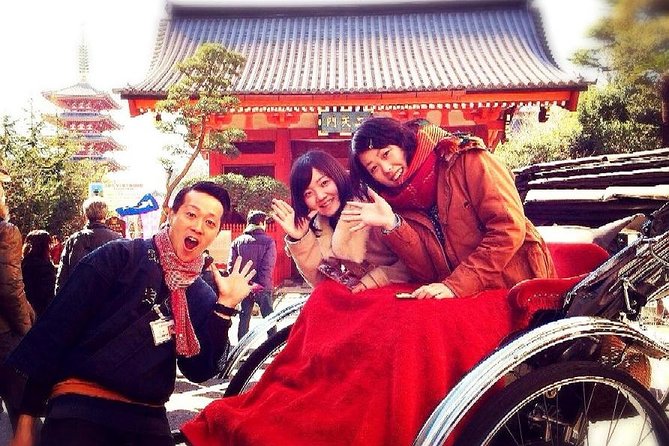
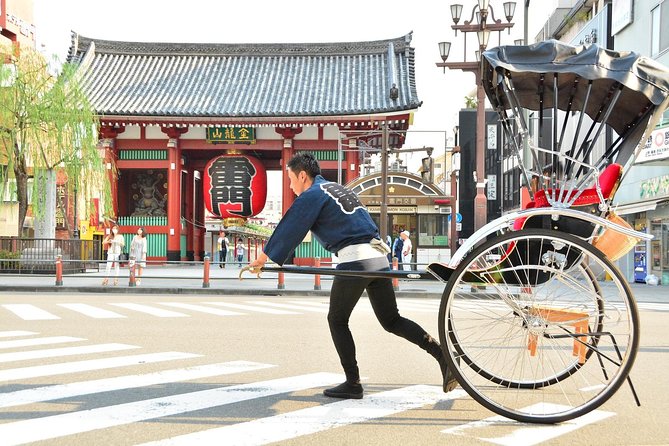
The colorful gate leading toward Sensoji Temple and Asakusa Shrine is one of Asakusa’s most recognizable scenes. The area is visually impressive, but it is also the busiest part of the neighborhood.
There is an important restriction here: rickshaws cannot ride inside the Sensoji and Asakusa Temple area, including the temple buildings, temple grounds, and Nakamise shopping street. Your guide can bring you near the area and explain what you are seeing, but you will need to walk through the temple grounds on your own.
Asakusa Shrine sits on the Sensoji grounds. It is a Shinto shrine beside an important Buddhist temple, making it a useful place to learn how the two traditions coexist in Japan. Your guide can explain the difference between Shinto and Buddhism without turning the stop into a formal lecture.
If your main goal is to explore Sensoji itself, do not assume the rickshaw replaces a walking visit. Use the ride to understand the area and reach nearby sights, then return on foot for the temple grounds, gate, and Nakamise shopping street.
Honryuin Matsuchiyama Shoden and the radish clue
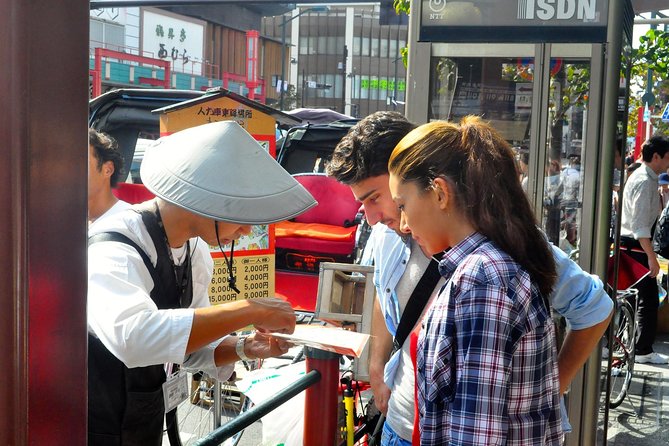
Honryuin Matsuchiyama Shoden is a Buddhist temple and one of the constituent temples connected with Sensoji. Its distinctive feature is the repeated use of radish imagery. Radishes appear at the temple and on its lanterns, and the guide explains why.
This is exactly the kind of stop that benefits from a local guide. Without context, the radishes may look like decoration. With an explanation, the temple becomes easier to remember and more interesting to compare with the larger Sensoji complex.
The listed visit takes about 15 minutes. Admission is not included. The temple is also part of the quieter side of Asakusa, so it can provide a welcome change from the main tourist lanes.
Imado Shrine and the lucky cat connection
Imado Shrine is a Shinto shrine known for cat figurines, especially the manekineko, or beckoning cat. If you like Japanese folk symbols, small shrines, or unusual photo subjects, this is a strong request for your route.
The shrine is listed as another 15-minute stop. Like Ushijima and Honryuin Matsuchiyama Shoden, it works best when you let the guide explain what you are seeing rather than rushing in for a photograph and leaving.
The route may also include a Japanese garden and the Lucky Fortune Cow Shrine. These smaller places give the ride its local character. You are not simply moving from one famous attraction to another. You are seeing the objects, legends, and religious customs that make Asakusa feel distinct.
What the price includes, and what it does not
The listed price is $42.90 per person. That is a reasonable price for a short private experience in central Tokyo, especially if you value a local guide, photos, and the ability to set the route.
The value improves with time. On a 30-minute ride, you are paying for a quick introduction and a pleasant way to cover nearby streets. On a longer ride, the same format becomes a fuller neighborhood tour with several shrines, river views, old streets, and cultural explanations.
The price includes the local rickshaw driver and the ride. Hotel pickup, hotel drop-off, food, and drinks are not included. A different finish point may also involve an extra drop-off charge payable on the day.
Two adults can share one rickshaw, but the seat is 74 centimeters wide. If you are broad-shouldered, prefer personal space, or simply want a more relaxed ride, book one rickshaw per passenger. If you arrive and discover that two people do not fit comfortably, an extra rickshaw may not be available with an English-speaking guide.
Children age six and older pay the adult rate. Children age five and younger can ride free on an adult’s lap, with up to two small children sharing a rickshaw with two adults. If a five-year-old uses one of the two seats, that child must be booked as an adult.
Who will enjoy this ride most
I would recommend this experience to first-time visitors who want a quick introduction to Asakusa, couples looking for an unusual way to see the district, families who need a break from walking, and photographers who want help finding good angles.
It also suits anyone curious about small religious sites. The main temple is famous, but the three-entrance gate at Ushijima, the radishes at Honryuin Matsuchiyama Shoden, and the cats at Imado Shrine are the details that make the neighborhood memorable.
It is less suitable if you dislike sitting close to another person, want a fully fixed sightseeing schedule, or expect the rickshaw to travel through the Sensoji temple grounds. It is also not the right choice if bad weather is likely and you have no flexibility to change the date.
Book as early as you can if you want a particular date or English-speaking guide. The experience is booked about 54 days in advance on average, and extra rickshaws may not be available at short notice.
Should you book the Tokyo Asakusa Rickshaw Tour?
Book it if you want a personal introduction to Asakusa rather than a simple ride past its main sights. The best version of this experience is a longer private route that includes Ushijima Shrine, the riverfront, Honryuin Matsuchiyama Shoden, Imado Shrine, and the old entertainment streets.
For a tight Tokyo schedule, choose 30 to 45 minutes and treat it as an orientation. For a deeper look at the neighborhood, choose two or three hours and tell the guide exactly what interests you.
The main questions are comfort and weather. Check the 74-centimeter seat width, book separate rickshaws if needed, and remember that the vehicle stops outside the Sensoji grounds. If those points work for you, this is a friendly, photo-filled way to see the many sides of Asakusa.
FAQ
Where does the Tokyo Asakusa Rickshaw Tour start?
The meeting point is outside Asakusa Station at 1-chōme-1-4 Asakusa, Taito City, Tokyo 111-0032, Japan.
How long does the rickshaw tour last?
Available tour durations range from about 30 minutes to three hours.
Is the tour private?
Yes. Only your group participates in the activity.
How many adults fit in one rickshaw?
A maximum of two adults can ride in one rickshaw. The rickshaw is 74 centimeters wide, so two adults may find it snug.
Can children ride for free?
Children age five and under may ride free on an adult’s lap. Up to two children age five or under can ride with two adults. A five-year-old using one of the two seats must be booked as an adult.
Can I choose what I see?
Yes. The route can be customized according to your interests. Not every listed landmark can fit into the shorter tours, so discuss your preferred stops with the guide.
Can the rickshaw ride inside Sensoji Temple?
No. Rickshaws are not allowed inside the Sensoji and Asakusa Temple area, including the temple buildings, temple grounds, and Nakamise shopping street.
Is hotel pickup included?
No. You make your own way to the meeting point. Hotel pickup and drop-off are not included.
What happens if bad weather cancels the tour?
If the experience is canceled because of poor weather, you can choose a different date or receive a full refund. You can also cancel for a full refund up to 24 hours before the start time.
Newly added rides around Japan
- Kamakura Rickshaw Tour★ 5.0 · 53 reviews
- Rickshaw Tour of Kagoshima’s Historical and Cultural Sites★ 5.0 · 4 reviews
- Kamakura Heritage Bike or Walk Tour with ex-Rickshaw guide★ 5.0 · 11 reviews
- Hakodate Rickshaw Tour★ 5.0 · 18 reviews
- [60 minutes] Rickshaw tour around Asakusa [Complete Asakusa tour/power spots]★ 5.0 · 38 reviews
- [30 minutes] Rickshaw tour around Asakusa [History, sightseeing, Tokyo Skytree]★ 5.0 · 38 reviews
- Tokyo: Asakusa tour by rickshaw★ 4.9 · 11 reviews
- Tokyo Vegan Tour : Miso Making, Tea Ceremony, Rickshaw Ride★ 5.0 · 2 reviews
Tokyo Tuk Tuk Tours: the nearest alternatives
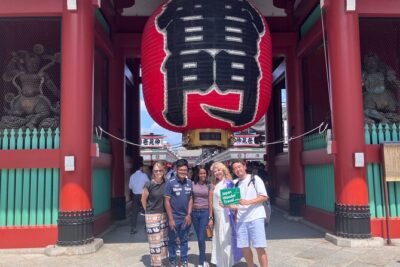
Asakusa, Tokyo: Rickshaw Experience and Highlights Walking tour
Read our review →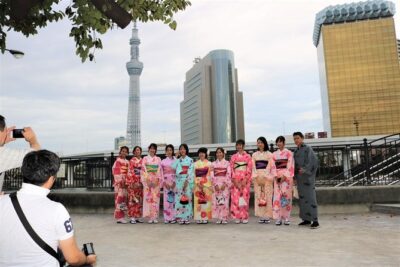
Ride a rickshaw wearing a kimono in Asakusa! Enjoy authentic traditional culture!
Read our review →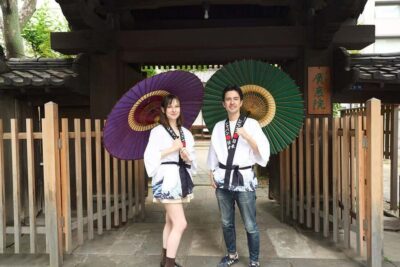
Tokyo Vegan Tour : Miso Making, Tea Ceremony, Rickshaw Ride
Read our review →Tuk tuk lists that include it